
Network access
The Network access panel controls where a request may come from. It is a layer on top of the token or OAuth sign-in: a valid credential is not enough. A request is allowed only when it comes from a source the site allows and the person’s own rules allow.
Different clients are checked differently: Claude and ChatGPT are recognised by their own networks or certificates; tools people run themselves — Claude Code, OpenCode — are recognised by the networks they connect from.
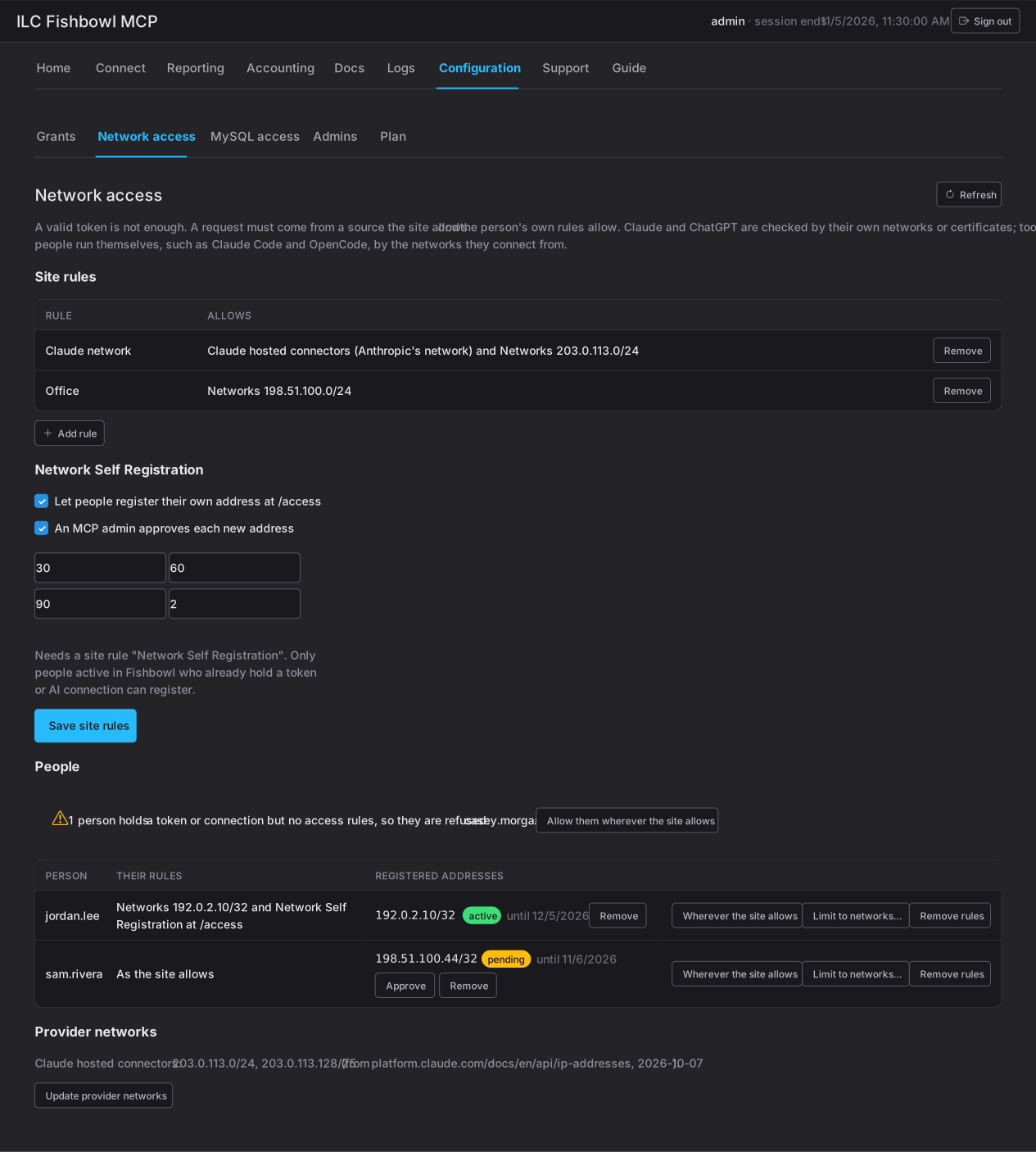
Site rules
Section titled “Site rules”Site rules are the sources allowed for the whole tenant. Add one per kind of client you support:
| Rule | Allows |
|---|---|
| Claude hosted connectors | Requests from Anthropic’s published network (claude.ai, Claude Desktop). Verifies the network, not the person. |
| ChatGPT (Cert) | Requests carrying OpenAI’s verified connector certificate (mTLS). Needs the app’s client certificate turned on. |
| ChatGPT (Network) | Requests from OpenAI’s published connector network, kept auto-updated from OpenAI’s published list. No certificate needed. |
| Networks (CIDR) | Office, VPN, or other fixed networks, IPv4 or IPv6 — for Claude Code, OpenCode, and other self-run tools. |
| Network Self Registration | People sign in at /access from the network they’re on, and that address is allowed for them. |
Saved rules apply to the next request of every token and connection, and the change is audited.
Network Self Registration
Section titled “Network Self Registration”If you add the Network Self Registration site rule, people can self-register
the network they’re working from at /access, instead of you collecting IPs by
hand. Only people active in Fishbowl who already hold a token or AI connection
can register. You control:
- Let people register at
/access, and whether an administrator approves each new address. - Lasts (days) — default 15 — and Inactive after unused (3) and Removed after unused (15).
- Most per person — default 5.
People
Section titled “People”The People list is per-person network rules. Each person can be set to:
- Wherever the site allows — inherit the site rules (the common case).
- Limit to networks — allow them only from specific CIDRs, and only where the site also allows.
- Remove rules — with none, their tokens and connections are refused from the next request.
Registered addresses show here too, each active, pending, or expiring on a date; a pending one can be approved or removed.
Provider networks
Section titled “Provider networks”The outbound IP ranges that identify the hosted connector networks. The two providers are handled differently:
- ChatGPT ranges are retrieved automatically from OpenAI’s published list
(
openai.com/chatgpt-connectors.json), refreshed when the stored set is older than about 12 hours. The refresh happens lazily on the access path — a real request while the set is stale triggers it — not on a timer. If a fetch fails or the list is malformed, the last good set stays; an empty set denies everything rather than opening up. These feed the ChatGPT (Network) rule. - Claude ranges are maintained by ILC from Anthropic’s published IP-address page — https://platform.claude.com/docs/en/api/ip-addresses. ILC support checks that page and sets the ranges through the Provider networks control, recorded with the source page and date. There’s no automatic refresh for Claude: Anthropic publishes the ranges as a web page rather than a machine-readable list.