
Sunrise 2027: what it actually requires from your Fishbowl implementation (and what it doesn't)
If someone forwarded you a Sunrise 2027 article and you’re wondering whether your barcodes are about to stop working: no. Sunrise 2027 is a retail point-of-sale initiative by big-box retailers and GS1. Retailers are upgrading checkout scanners to read 2D barcodes (QR codes and DataMatrix), and brands are adding those codes to consumer packaging. There is no law behind it, and nothing in your Fishbowl install breaks in 2027. But if your products cross a retail checkout, or your customers’ products do, it will reach you eventually, through your trading partners rather than through GS1.
What Sunrise 2027 is
Sunrise 2027 is GS1 US’s target date for retailers to be able to scan 2D barcodes at the register. The two formats are QR codes carrying a GS1 Digital Link URI, and GS1 DataMatrix. Both carry the same GTIN that lives in today’s UPC, and can carry more: lot numbers, expiration dates, serial numbers, or a URL that resolves to product information.
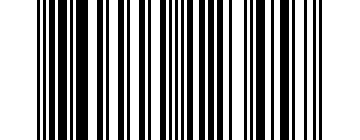
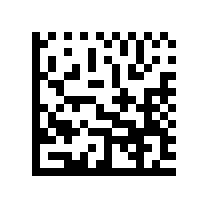
Dual marking: the UPC and a GS1 DataMatrix carrying the same GTIN — plus an expiration date and lot number the UPC has no room for.
GS1’s own page says it is not necessary to implement everything by 2027. There is no regulator, no fine, and no date on which 1D barcodes stop scanning. The transition guidance is dual-marking: packaging carries both the UPC and the new 2D code (GS1 recommends keeping them within 50 mm of each other so POS scanners pick up both). From 2028 onward the choice of 1D, 2D, or both is the manufacturer’s. The UPC is not going away in 2027, and most coverage of this topic buries that.
Whose problem it is
Directly yours if you sell branded product through retail checkout lanes. Those retailers are the ones upgrading scanners, and they will eventually tell suppliers what they want on the package. If you private-label for a retailer, expect the requirement to arrive in a packaging spec revision, not a press release.
Indirectly yours if you’re upstream of someone in that first group. This is how most businesses running Fishbowl will feel it. You do wholesale or distribution and never see a checkout lane, and then a customer’s packaging spec starts requiring a 2D symbol on the retail unit. Now your labels, your GTIN management, and possibly your label printing are part of their transition.
Mostly not yours if you’re pure B2B. Your Code 128 case labels and internal part-number barcodes are not in scope, and reacting in 2026 would be early. One caution: a business that is B2B today but sells through even one retail or marketplace channel is in the first group for that channel’s SKUs.
What “adding a 2D barcode” means
The minimum is small: keep your UPC and add one 2D symbol that carries the GTIN, the same identifier your UPC already encodes. Everything past that minimum is where the work is.
Encoding lot, expiry, or serial into the symbol only helps if your systems track those values per lot or per unit. Encoding an expiration date you don’t manage in inventory is decoration. And if you go the Digital Link route, the QR resolves to a URL that someone has to keep alive for the shelf life of everything that carries it. The second symbol also has to physically fit, which on small packaging is an artwork problem before it’s a systems problem.
For a Fishbowl implementation, the underlying question is where the GTIN and per-lot data live and whether your label printing can produce the symbol. Short version: Fishbowl’s UPC field holds a GTIN-14 fine, the lot/expiry/serial tracking has the data, but the label designer has no native QR support. Getting a compliant 2D symbol printed takes custom report work, or printing ZPL directly to a thermal printer. The full breakdown is in the next post in this series.
What to do in 2026
- List your channels and top customers, and mark which ones end at a retail checkout. If the answer is none, write that down too.
- Ask your retail-facing customers what’s coming. One question to your buyer contact (“are you planning 2D barcode requirements for suppliers, and when?”) gets you a date instead of a rumor.
- Check your label printing. The stock Fishbowl label designer can’t render a QR code; plan for custom report work or ZPL to a thermal printer.
- Check your warehouse scanners. Laser scanners cannot read matrix codes at all; you need camera-based imagers.
- Don’t panic-buy anything. The concrete requirements will come from a specific trading partner with a specific spec.
What to watch for
Packaging spec revisions from any retail customer, and what big retailers do with their private-label lines. The second is already moving: in the UK, Tesco moved an entire own-label range to GS1-powered QR codes in 2026. Expect US chains to follow the same private-label-first pattern.
When either signal shows up, the work turns specific: GTIN hygiene, label rendering, and where lot and expiry data live in your inventory system. That’s the rest of this series.
Related: